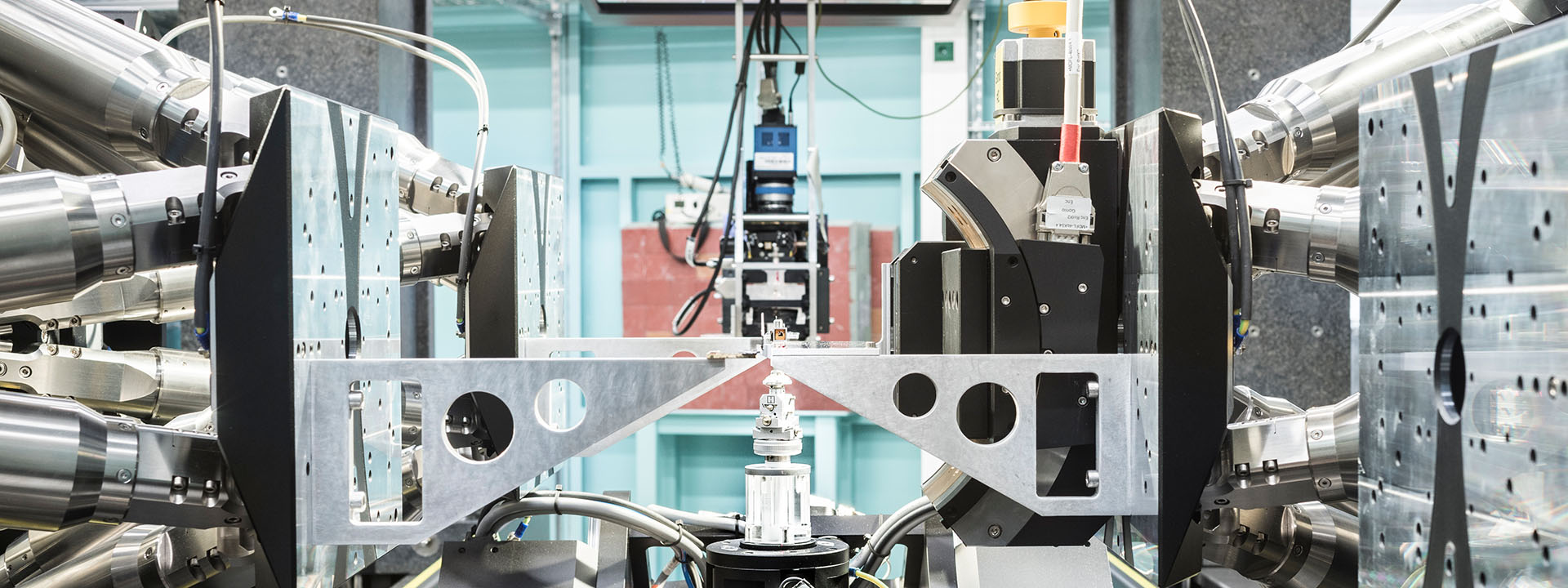
Synchrotron photon sources offer an extremely wide energy spectrum, ultra-small beam dimensions and extreme temporal resolution, making it possible to investigate a huge range of dynamic processes in materials and biological systems.
At IPS we develop and apply synchrotron-based in situ & operando X-ray imaging, X-ray spectroscopy, and X-ray scattering techniques within the framework of the Helmholtz Research Program "From Matter to Materials and Life" (MML). Our research comprises pioneering, proof-of-principle experiments as well as systematic studies, which advance our understanding of the relationships between structure, function and behaviour in materials research and the life sciences. For this purpose the IPS operates the three state-of-the-art SPECTROSCOPY, SCATTERING and IMAGING Clusters, incorporating beamline and laboratory instrumentation at the KIT Light Source together with facilities at the synchrotron sources at PETRA III, the ESRF and the ALS.
Our research activities are closely linked to teaching and research within the KIT Faculties of Physics and Chemistry & Biosciences, and we work in close cooperation with other KIT institutes and with leading national and international research institutions and universities.

A previously unknown damage mechanism under shear loading has been identified using X-ray computed laminography and validated through advanced finite element modelling. The results have been published in the International Journal of Plasticity.
more
We were pleased to host Magali Laviani, a PhD student from the Instituto de Investigaciones Fisicoquímicas Teóricas y Aplicadas (INIFTA) of the Universidad Nacional de La Plata, Argentina, for a six-week research stay at IPS. Her visit was supported by the DAAD (Deutscher Akademischer Austauschdienst, German Academic Exchange Service).
more
On April 23, 2026, this year's "Girls' Day - Girls' Future Day" took place. The Girls' Day is a nationwide careers orientation day for girls. The Girls' Day gives schoolgirls the opportunity to gain insights into professional fields that are rarely chosen by women - fields in the natural and technical sciences.
more
The HERCULES European School in Grenoble, France, is dedicated to train students and scientists from European universities and laboratories. Recently, participants of the school completed an internship at KIT. During their stay, they attended lectures, tutorials and practical courses at the KIT Light Source.
more