
In situ laminography reveals particle-induced damage growth under shear
Lightweight aluminium alloys are widely used in transportation to reduce fuel consumption and improve efficiency. Improving their formability and durability is therefore important for sustainable mobility. Microscopic features such as intermetallic particles (small material heterogeneities) can strongly influence damage development and material failure.
While failure mechanisms under tensile loading are rather well understood, the processes governing damage under shear loading remain largely unclear. This is particularly relevant because many engineering materials may experience shear deformation during manufacturing and service.
The experiment was enabled by the unique in situ laminographic capabilities of IPS. X-ray computed laminography is a tomographic method designed to investigate the three-dimensional microstructure of flat and laterally extended specimens.
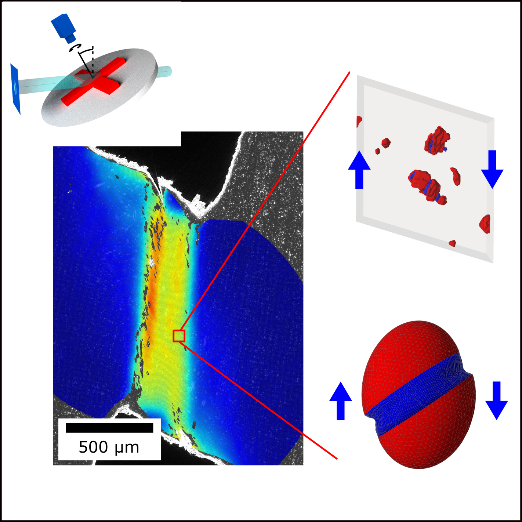
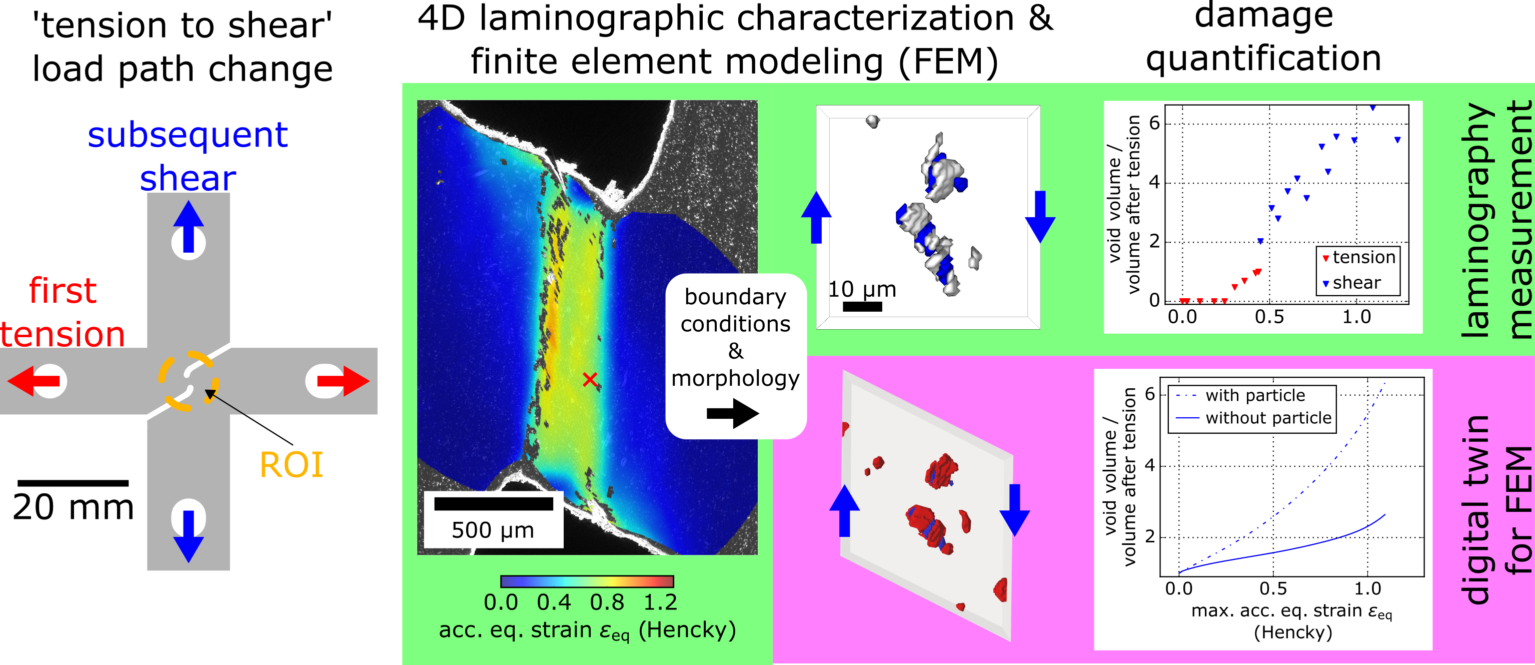
The approach allowed the study of a specifically designed load-path-change specimen (see Fig. 1), enabling damage to be nucleated in a controlled way and then observed under simple shear loading.
The laminographic measurements allow to measure mesoscale deformation and microscale morphology in the material (see Fig. 1). It is found that stiff intermetallic particles induce significant damage growth under shear loading. Microscopic voids increased in volume by more than 600% during deformation. (see Fig. 1)
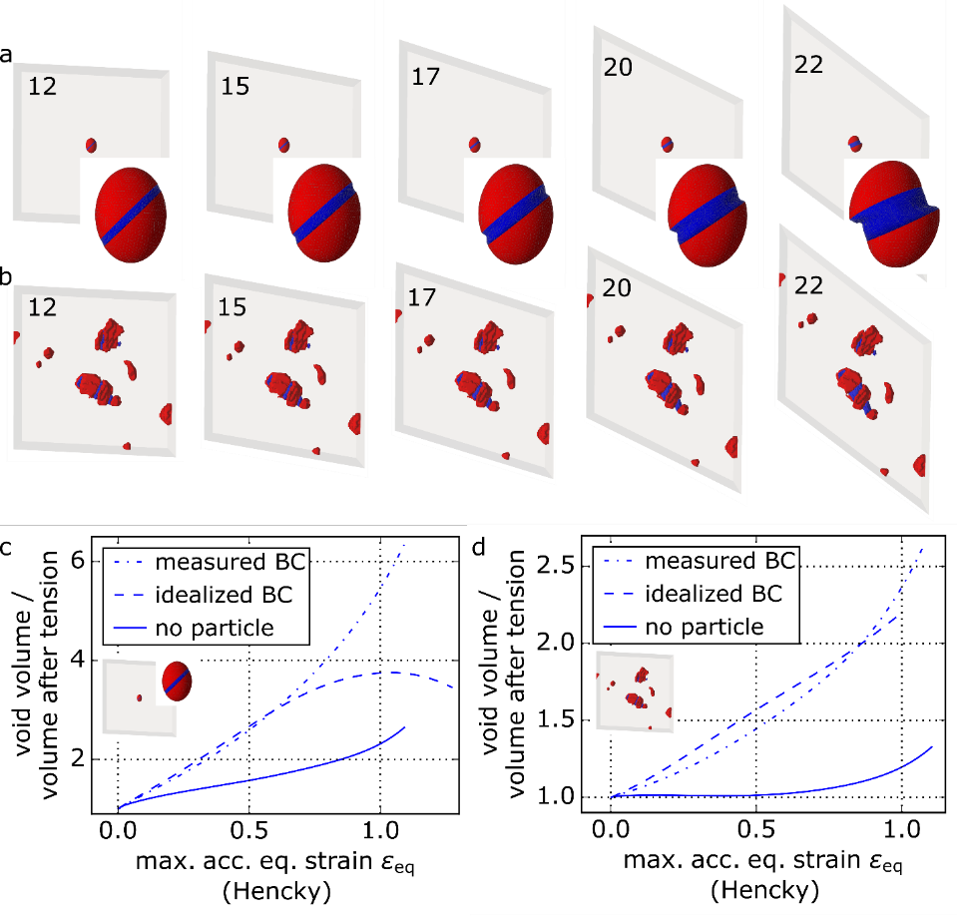
These findings are supported by advanced finite element simulations (see Fig. 2) based on a digital twin of the material, enabling detailed analysis of the underlying mechanisms. Key boundary conditions for the simulations, including deformation and initial morphology, were extracted from the laminographic measurements combined with image correlation techniques.
The simulations reveal that differences in stiffness between the aluminium matrix and intermetallic particles drive the strong damage growth observed in the material.
A better understanding of damage mechanisms under shear will enable more precise failure predictions of mechanical components. This knowledge can then be translated into improved design paradigms for lightweight engineering, leading to enhanced formability, durability and reliability of structural parts.
M. Hurst, J.-M. Scherer, X. Kong, M. Gille, S. Bode, D. Missoum-Benziane, T. Baumbach, L. Helfen, T. F. Morgeneyer, Int. J. Plast. 203, 104724, 2026
https://doi.org/10.1016/j.ijplas.2026.104724
ESRF spotlight article:
https://www.esrf.fr/home/news/spotlight/content-news/spotlight/in-situ-laminography-reveals-particle-induced-damage-growth-under-shear.html